What we do

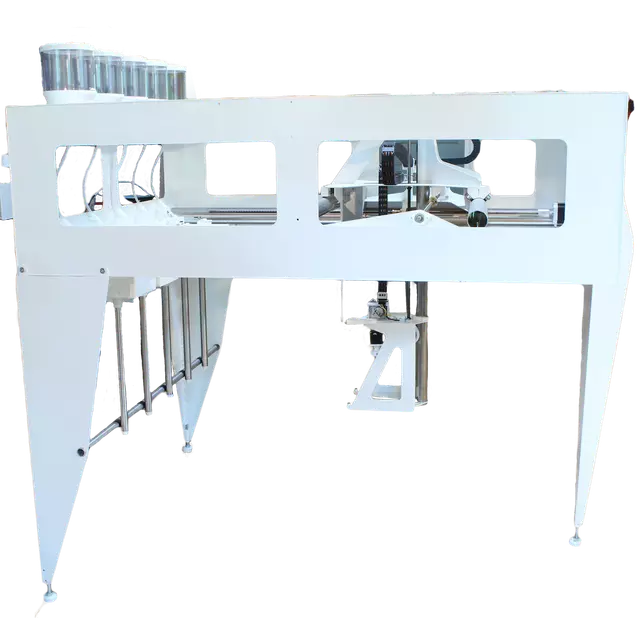
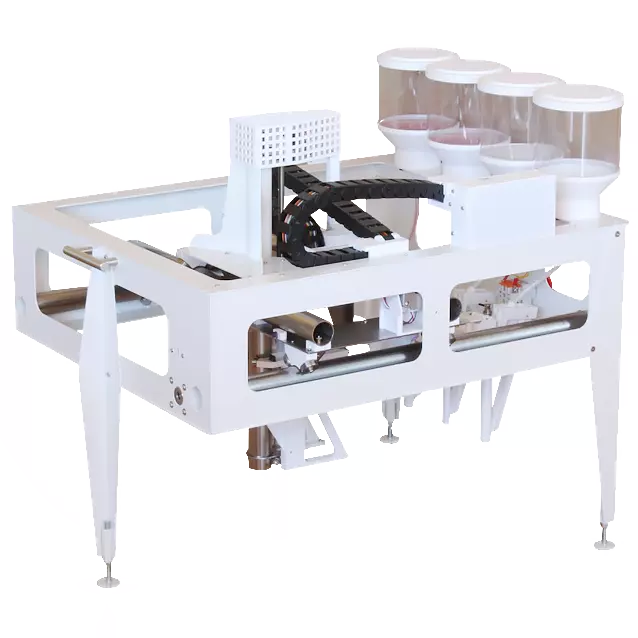
We manufacture metal 3D printers, which use the newest 3D printing process - Selective Powder Deposition (SPD).

How Selective Powder Deposition works

Overview

Selective Powder Deposition (SPD) is a new 3D printing process, which you can use to print metal, glass, ceramic, and composite materials. There are 2 main variants: infilling and sintering. With infilling you get a 100% solid object, and with sintering you usually get a porous object. The best metal 3D printer video helps visualizing it.

Variant 1 - SPD with infill

First, the 3D printer selectively deposits build and support powders into a crucible. When it finishes filling the whole crucible, you add some infill material, and bake it in a kiln. The temperature in the kiln should be above the melting temperature of the infill, but below the melting temperature of the powders. When the infill melts, it soaks the build powder, but it doesn't soak the support powder, because the support powder is chosen such that it's not wettable by the infill.

To prevent metal oxidation, the atmosphere in the crucible should be reducing. The easiest way to create a reducing atmosphere is to place some carbon (metallurgical coke) or hydro-carbon (plastic) in the crucible. But some metals require a controlled atmosphere furnace with hydrogen and argon.

After the infilling, if you cool down the crucible quickly - you'll get a composite material, because the atoms of the build powder and the infill didn't have enough time to mix. But if you hold it at high temperature for a while - the atoms of the build powder and the infill will diffuse and mix with each other, so you'll get a uniform alloy. The time required for diffusion depends on the metals and temperature. For example, at 790°C, copper+tin can mix uniformly in 2 hours and you'll get bronze. But copper and tungsten, even at 1090°C, won't alloy much even in a day, so you'll get a composite.

When it cools down, remove it from the kiln, and clean it with a wire brush or sand blaster.

Variant 2 - SPD with sintering

The 2nd variant, sintering - is even simpler - you just don't add any infill, and bake it at the temperature sufficient to sinter the build powder. Note that sintering causes shrinkage and warping. By changing the baking temperature, you can influence the amount of shrinkage, warping and porosity. With sintering it's hard to achieve 100% density with pure metals (those that have a single melting point), but it's easy with glass, and some metal alloys, though it requires a vacuum furnace.

Materials

In theory, SPD can be used to 3D print almost any material. Actually, the printer itself is material agnostic, and can pour any powder that flows through a small hole. But when it comes to baking, some materials are easier than others. For the details see Which materials can be 3D printed with SPD
Advantages

Parts are 100% solid.

Selective Powder Deposition is the only method that can produce 100% solid metal 3D prints.

Laser printers can't do that, because they melt metal one pixel at a time, and it solidifies one pixel at a time. During the solidification metal shrinks and breaks away from the neighboring pixels, causing voids and warping.

No warping or internal stress

SPD with infill is the only metal 3D printing method that doesn't cause any warping or internal stress. This is because the printed object is warmed up and cooled down all together without any sharp thermal gradients.

In contrast, laser printers use localized melting, which causes localized shrinkage, and thus warping. And the processes that rely on sintering always have some warping due to uneven shrinkage.

Versatile - can 3D print many different materials, even glass

SPD can be used to 3D print many different materials.

Comparison of metal 3D printing methods

Cost Internal stress Shrinkage Porosity Strength Min feature size Shape limitation Max size Reactive metals6
Laser, SLS, SLM, EBM, DMLS high high1 none med med small med1 med easy
Directed Energy Deposition (DED) high high1 none med med med high1 large easy
MIG welding med very high1 none med med large high1 large easy
FDM or Binder Jet + sintering in air low none high2,3 high2,3 low2,3 small med small hard
FDM or Binder Jet + sintering in argon high none high2,3 med2,3 med2,3 small med small hard
SPD with infill low none none none high med low large hard
SPD with sintering low none low2,4 high2,4 low2,4 med low large hard

1 Localized heating and cooling causes internal stress and warping, so large solid objects cannot be printed without cracking. Workaround: print with sparse infill and additional support structures. Though this requires manual removal of the supports, and limits the shapes, because it is impossible to remove the supports from internal cavities.

2 With sintering, shrinkage and porosity can be traded for one another - reducing the particle size or increasing the temperature or time - results in lower porosity and higher strength, but higher shrinkage. And vice versa.

3 With FDM and Binder Jet sintering, the powder particle size must be small, so the shrinkage is high, porosity is medium, and strength is medium. Sintering in argon rather than air - increases the strength, but increases the price.

4 With SPD, the powder particle size must be large, so when the powder is non-viscous, like metals, the shrinkage is low, porosity is high, and strength is low. With viscous powders, like glass, the shrinkage is high, porosity is low or none (in vacuum), and the strength is high.

5 Glass (and some alloys) become viscous at high temperatures, so sintering them naturally results in low porosity. And when using a vacuum furnace - 0% porosity and full strength can be achieved. This is very useful for glass - it makes it transparent.

6 Is it easy to print reactive metals? (metals that eagerly react with oxygen, like: titanium, aluminum, chromium, vanadium, magnesium, silicon, etc.)

Comparison of sand 3D printing methods

Cost Min feature size Shape limitation Moisture tolerance Controllable collapsibility Multiple materials Max size Speed
Binder Jetting high small med1 no no no large high
SPD with sintering low med low2 yes yes3 yes4 large med5

1 With Binder Jetting, after printing, to remove partly bound sand, every surface must be cleaned with a brush and compressed air. So, every surface must be accessible, which prohibits complex internal geometries.

2 With SPD, unbound sand can be simply poured out. Any few remaining sand particles can be removed by shaking or washing with water. So, complex internal geometries are possible, as shown in DIY 3D printing of sand mold for metal casting video.

3 With SPD, collapsibility of different regions of the mold can be controlled independently by using different shell sands with different grain sizes and different binder amounts.

4 SPD allows different materials to be deposited in different regions. For example: a thin layer of zirconia sand can be deposited around the casting, and metal shot (chill) can be deposited near the regions that need to be cooled down first.

5 With SPD, speed depends on the object's complexity. For small and complex objects SPD is slower than Binder Jetting. For large and simple objects SPD is faster than Binder Jetting.

Comparison of glass 3D printing methods

Cost Min feature size Shape limitation Transparent Shrinkage Multiple materials Max size Speed
FDM med small high1 almost none yes small high
SPD with sintering in air low small low no high yes large med
SPD with sintering in vacuum med small low yes2 high yes large med
SPD with infill low small low almost3 none yes large med

1 With glass FDM, localized cooling causes cracking. So, only hollow vase-like objects can be printed.

2 To print transparent objects with SPD, zirconia must be used for the fine support powder, because it doesn't stick to the glass. Zirconia is expensive, but we need only a small amount of it. Also, it is reusable - after the print, it can be reclaimed by sieving.

3 SPD with glass infill produces transparent objects, but because the coefficients of refraction of the infill and the build powder are different (1.51 vs 1.55), the optical properties are not as good as with pure glass.

Products and specifications

iro3d logo

Model-C

3D Printing process: Selective Powder Deposition (SPD)
Build volume, mm: L:279, W:274, H:110
Printer size, mm: L:690, W:530, H:610
Shipping box size, mm: L:770, W:620, H:440
Shipping weight: 24 kg
Power: 12V DC or 100-240V AC, 40W
Pourer diameters, mm: 1.9 + (0.9 or 3.9)
Min layer height: 0.1 mm
Min width of a detail: one pourer diameter
Min height of a detail: one layer height
Buy
iro3d logo

Model-G

3D Printing process: Selective Powder Deposition (SPD)
Build volume, mm: L:610, W:610, H:310
Printer size, mm: L:1420, W:1016, H:1102
Shipping box size, mm: L:1600, W:1300, H:1500
Shipping weight: ~350kg
Power: 24V DC or 100-240V AC, 60W
Pourer diameters: 1.9 mm, 3.9 mm, 9.8 mm
Min layer height: 0.1 mm
Min width of a detail: one pourer diameter
Min height of a detail: one layer height
Buy